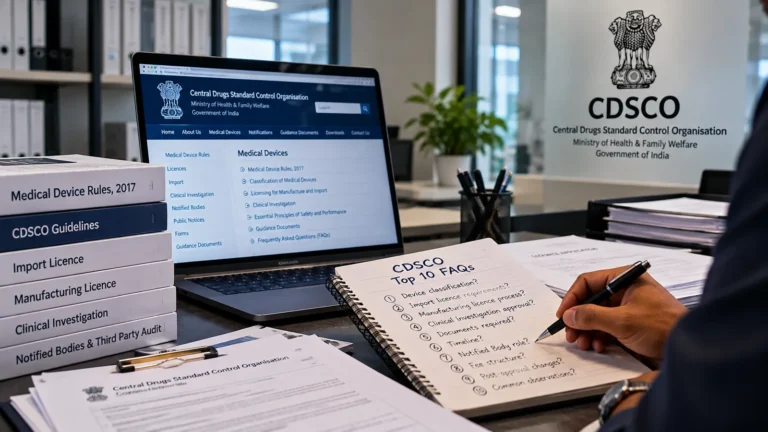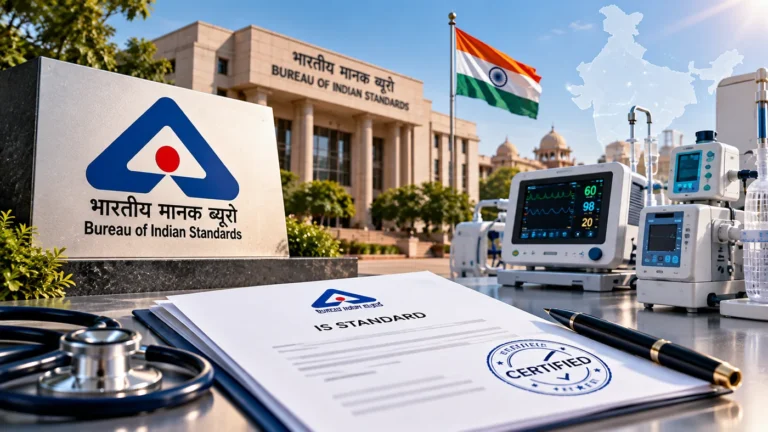
“Do we need BIS or CDSCO?” is one of the most common questions we are asked, and the premise is usually wrong. They are not alternatives. They are two separate approval systems run by two different authorities, and a product can need one, the other, both, or neither.
Two authorities, two questions
CDSCO is the drug and medical device regulator, operating under the Medical Devices Rules, 2017. It asks whether a device is safe and performs as intended, and it controls who may manufacture, import, sell and distribute it.
The Bureau of Indian Standards is the national standards body. It asks whether a product conforms to a specific Indian Standard, and where a product falls under a compulsory registration or certification order, it controls whether that product may be sold at all.
The two questions are independent. A device can be perfectly compliant with an Indian Standard and still be unsellable without a CDSCO licence, and it can hold a CDSCO licence and still be non-compliant for want of an ISI mark.
When CDSCO applies
CDSCO applies to notified medical devices and in vitro diagnostics, which under the Medical Devices Rules, 2017 now covers all devices. Classification into Class A, B, C or D follows risk, and the licence you need follows the class and the activity:
- Manufacture of Class A or B devices — Form MD-5, granted by the State Licensing Authority
- Manufacture of Class C or D devices — Form MD-9, granted by the Central Licensing Authority
- Import of any class — Form MD-15, held by an Indian entity, which for an overseas manufacturer means appointing an Indian Authorised Agent
- Sale, stock or distribution — Form MD-42 wholesale registration
When BIS applies
BIS certification becomes compulsory when a product is brought under a Quality Control Order or listed under the Compulsory Registration Scheme. For medical and hospital products, this has expanded steadily, and the practical answer is always product-specific: check whether your exact product category appears in a current order, and which Indian Standard it is tied to.
Two routes exist. Domestic manufacturers apply under the ISI Mark scheme, which involves factory inspection and sample testing against the relevant IS. Overseas manufacturers apply under the Foreign Manufacturers Certification Scheme, which adds an Indian representative and a higher fee structure but follows the same technical logic.
Where both apply at once
The overlap is wider than most manufacturers expect. Hospital furniture, certain disposables, some electro-medical equipment and a range of laboratory products can sit inside both systems. Where that happens, the sequence matters more than the paperwork:
- Confirm the device classification under the Medical Devices Rules, 2017 and identify the CDSCO route.
- Check the product against current BIS orders and identify the applicable Indian Standard.
- Where both apply, start the BIS testing early. Sample testing against an IS has a laboratory queue that is not inside your control, and it frequently becomes the critical path.
- Align the technical description across both files. A product described one way to CDSCO and another way to BIS invites queries from both.
The mistakes that cost time
- Assuming a CE certificate or an FDA clearance substitutes for either. It does not. Both systems are national and neither recognises foreign approvals in place of their own assessment.
- Treating BIS as a formality. It is a test-based scheme. If the product does not meet the Indian Standard, no amount of documentation fixes it, and the redesign is on you.
- Leaving the standard unverified. Indian Standards are revised. Testing against a superseded version of an IS is a wasted test cycle.
- Appointing separate representatives. An Indian Authorised Agent for CDSCO and a different representative for BIS is legal but creates two versions of the truth about your product. Where possible, keep the technical file in one hand.
Frequently asked questions
Does every medical device need BIS certification?
No. BIS certification is compulsory only where the product falls under a Quality Control Order or the Compulsory Registration Scheme. Many medical devices do not. The answer must be confirmed product by product against current orders.
Can we sell with a BIS licence but no CDSCO licence?
No, not for a regulated medical device. A BIS licence says the product meets an Indian Standard. It does not authorise manufacture, import or sale of a medical device, which is CDSCO’s jurisdiction.
We are an overseas manufacturer. Which BIS scheme applies?
The Foreign Manufacturers Certification Scheme. It requires an authorised Indian representative, factory inspection at your overseas site and testing in a BIS-recognised laboratory in India.
Which comes first, BIS or CDSCO?
They can run in parallel, and usually should. BIS sample testing has the longer and less predictable lead time, so start it first even though the CDSCO licence is the one that ultimately permits sale.
How long is a BIS licence valid?
Typically issued for an initial period and renewable thereafter, subject to continued conformity, surveillance and payment of marking fees. Confirm the current period for your scheme at the time of application.
Medfins International handles both routes. Our BIS licence and ISI mark support covers standard mapping, test coordination and the grant process; the CDSCO manufacturing licence and CDSCO import licence routes are set out separately. The full scope is on our services page.