Your IVD has been sold in Europe under Directive 98/79/EC for years, perhaps self-declared without a notified body. Under Regulation (EU) 2017/746 (the IVDR) it now needs a notified body, and you have heard three different dates from three different people: 2025, 2027 and 2029.
Each was right at some point. The IVDR transition period has been amended twice, most recently by Regulation (EU) 2024/1860. This article sets out the dates now in Article 110 IVDR, the conditions attached to them, and which deadlines are still open in late 2026.
How the IVDR transition period got here
The IVDR has applied since 26 May 2022. Regulation (EU) 2022/112, adopted on 25 January 2022, introduced staggered transition dates for legacy devices: 26 May 2025 for class D, 26 May 2026 for class C, and 26 May 2027 for class B and sterile class A.
Regulation (EU) 2023/607 then removed the sell-off limit: under Article 110(4), devices lawfully placed on the market under Directive 98/79/EC may continue to be made available on the market or put into service with no time limit.
Regulation (EU) 2024/1860 of 13 June 2024 was published in the Official Journal on 9 July 2024 and entered into force that day. Its recitals record that notified body capacity was still not sufficient, that the transition had not progressed as hoped, and that there was a risk of shortages, especially of class D devices. It replaced the dates and attached conditions modelled on the MDR extension.
The IVDR transition period by class
Devices with an IVDD notified body certificate (Article 110(3a)) — devices whose IVDD conformity assessment involved a notified body. These may be placed on the market until 31 December 2027. Under Article 110(2), certificates under Directive 98/79/EC that were valid on 26 May 2022 remain valid beyond the period printed on them until 31 December 2027.
Self-declared IVDD devices that now need a notified body (Article 110(3b)) — devices whose IVDD conformity assessment did not require a notified body, whose declaration of conformity was drawn up before 26 May 2022, and which now require a notified body under the IVDR:
- Class D: until 31 December 2027
- Class C: until 31 December 2028
- Class B and class A placed on the market in sterile condition: until 31 December 2029
These are dates for placing on the market. After them, new units need an IVDR certificate.
Conditions and the application deadlines (Article 110(3c))
The dates apply only if every condition in Article 110(3c) is met:
- (a) the devices continue to comply with Directive 98/79/EC;
- (b) there are no significant changes in the design and intended purpose;
- (c) the devices do not present an unacceptable risk to the health or safety of patients, users or other persons, or to other aspects of public health;
- (d) no later than 26 May 2025, the manufacturer had put in place a quality management system in accordance with Article 10(8) IVDR;
- (e) a formal application with a notified body for the legacy device, or a device intended to substitute it, lodged by the date for its group;
- (f) a written agreement with that notified body signed by the date for its group.
| Group | Formal application by | Written agreement by | Placing on market until |
|---|---|---|---|
| Certificate devices (3a) and class D | 26 May 2025 | 26 September 2025 | 31 December 2027 |
| Class C | 26 May 2026 | 26 September 2026 | 31 December 2028 |
| Class B and sterile class A | 26 May 2027 | 26 September 2027 | 31 December 2029 |
As of November 2026, the only application and agreement dates still ahead are those for class B and sterile class A. The quality management system date of 26 May 2025 applies to every group, including class B.
Expired certificates, surveillance and vigilance
Certificates that expired before 9 July 2024 count as valid until 31 December 2027 only if, before expiry, the manufacturer and a notified body had signed a written agreement under Annex VII, Section 4.3, second subparagraph, for the device or a substitute, or if a competent authority had granted a derogation under Article 54(1) or required the conformity assessment under Article 92(1).
Under Article 110(3d), IVDR requirements on post-market surveillance, market surveillance, vigilance and registration of economic operators and devices apply to legacy devices instead of the Directive requirements.
Under Article 110(3e), the notified body that issued the IVDD certificate remains responsible for appropriate surveillance unless the manufacturer agrees with an IVDR-designated notified body that it will take over. No later than 26 September 2025, the notified body that signed the written agreement became responsible for surveillance of the devices it covers.
Two other changes in Regulation (EU) 2024/1860
Supply interruption notice (Article 10a IVDR). From 10 January 2025, where a manufacturer anticipates an interruption or discontinuation of supply and it is reasonably foreseeable that this could result in serious harm or a risk of serious harm to patients or public health in one or more Member States, it must inform the competent authority where it or its authorised representative is established, and the economic operators, health institutions and healthcare professionals it supplies directly. The notice must be given at least six months beforehand, other than in exceptional circumstances. If you plan to drop legacy assays rather than certify them, this applies.
In-house devices. The condition in Article 5(5)(d) — that a health institution justifies why an equivalent device on the market cannot meet the target patient group’s needs — now applies from 31 December 2030 instead of 26 May 2028.
Where this goes wrong
- Reading 2029 as the deadline for class B. The date that decides eligibility is 26 May 2027 for the application and 26 September 2027 for the written agreement. Miss those and the 2029 date does not apply.
- Applying with a thin file. A formal application still needs IVDR technical documentation and a performance evaluation behind it. Scientific validity, analytical performance and clinical performance evidence for legacy assays is where most questions arise.
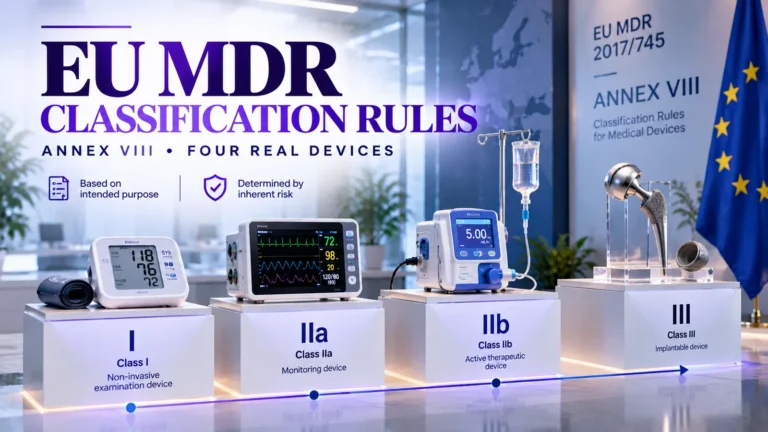
- Getting the class wrong. The dates follow the IVDR class under Annex VIII. Most devices that were self-declared under the IVDD now fall into a class that needs a notified body, and the class you assume decides which date and which application deadline you are working to. Confirm it rule by rule before choosing a date.
- Changing the assay during the transition. A new intended use, specimen type or design change can break condition (b). MDCG 2022-6 (4 May 2022) gives guidance on significant changes under Article 110(3) IVDR; check it, and ask the notified body when unsure.
- Leaving the variants out. The application and agreement must cover the device actually sold, or its intended substitute. Kits, calibrators and controls missing from the scope can fall outside.
- Running vigilance under the Directive. IVDR vigilance and post-market surveillance already apply to legacy devices.
Frequently asked questions
When does the IVDR transition period end for class B devices?
Self-declared IVDD devices that are class B under the IVDR may be placed on the market until 31 December 2029 under Article 110(3b), as amended by Regulation (EU) 2024/1860. That depends on a quality management system in place by 26 May 2025, a formal application to a notified body by 26 May 2027 and a written agreement by 26 September 2027.
What is the deadline for class D IVDs?
Class D devices that were self-declared under the IVDD, and devices holding an IVDD notified body certificate, may be placed on the market until 31 December 2027. The application had to be lodged by 26 May 2025 and the written agreement signed by 26 September 2025, along with the other Article 110(3c) conditions.
Is my IVDD certificate still valid after its printed expiry date?
If it was valid on 26 May 2022 and has not been withdrawn, Article 110(2) extends it until 31 December 2027. If it expired before 9 July 2024, it counts as valid only where a written agreement with a notified body was signed before expiry or a competent authority acted under Article 54(1) or 92(1).
Can distributors sell legacy IVDs after the transition dates?
Yes, for units already lawfully placed on the market. Since Regulation (EU) 2023/607, Article 110(4) IVDR allows such devices to continue to be made available on the market or put into service without a time limit. What ends at each date is the manufacturer’s ability to place new legacy units on the market.
Will the Commission’s proposal change the IVDR dates?
The Commission published a proposal to simplify the MDR and IVDR on 16 December 2025. It is under negotiation and is not law. Until the European Parliament and Council adopt a final text, the dates in Article 110 as amended by Regulation (EU) 2024/1860 apply, and plans should be built around them.
If your class B or sterile class A portfolio is heading for the 2027 application date, Medfins can help you prepare. We have supported more than 100 clients across 175+ regulatory projects and 250+ products. Our EU IVDR CE marking support covers classification, technical documentation, performance evaluation and notified body preparation; talk to our IVDR team about your devices.