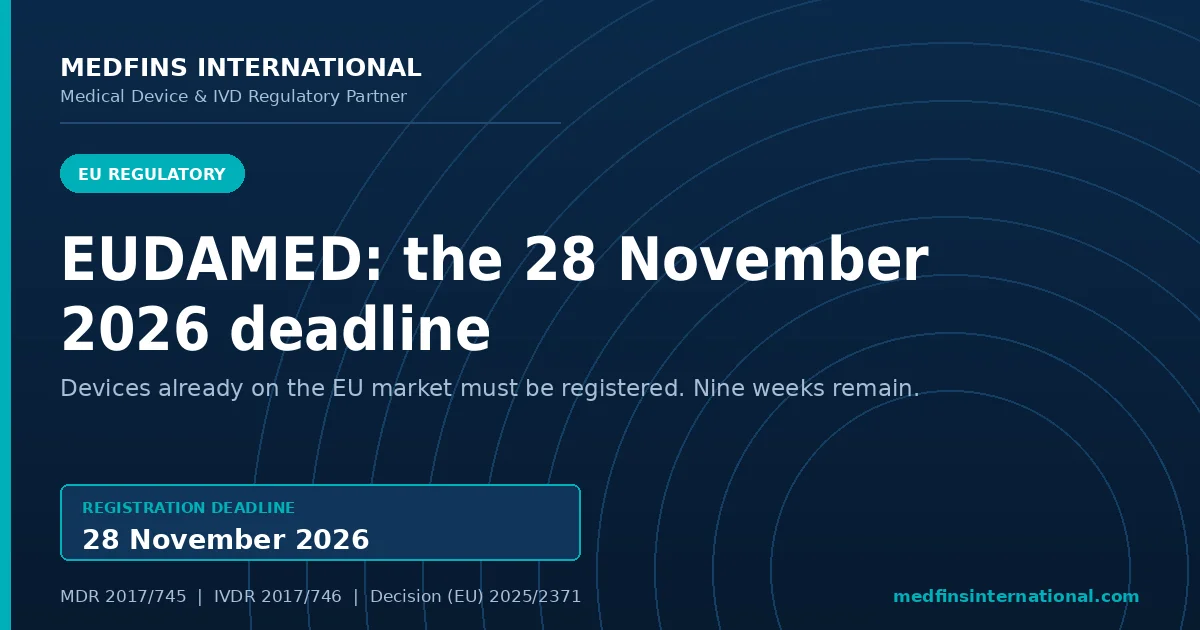
Most manufacturers dealt with EUDAMED in May. They registered as an actor, obtained or confirmed a Single Registration Number, and registered the devices they were about to launch. The second half of the obligation is the one being missed, and it closes on 28 November 2026.
That date applies to devices that were already on the EU market before mandatory use began, and that you intend to keep supplying. If a device was being sold in Europe in April 2026 and is still being sold today, it needs a EUDAMED record by 28 November 2026. Nine weeks remain.
How the deadline arises
The European Commission adopted Decision (EU) 2025/2371, published in the Official Journal on 27 November 2025, confirming that four EUDAMED modules are functional:
- Actor registration
- UDI/Device registration
- Notified Bodies and Certificates
- Market Surveillance
Under the phased rollout introduced by Regulation (EU) 2024/1860, the obligations attached to a module become applicable six months after that notice is published. The Commission confirmed the resulting date publicly: the first four modules became mandatory to use from 28 May 2026.
The Commission’s own EUDAMED Q&A sets out two further periods measured from the same notice. Devices placed on the market before the module became mandatory must be registered within twelve months of the notice, which gives 28 November 2026. Certificates issued before that date must be uploaded by notified bodies within eighteen months, which gives 28 May 2027.
Two modules remain outside this set and are still under development: Vigilance and Post-Market Surveillance, and Clinical Investigations and Performance Studies. Their obligations will follow the same six-month mechanism once the Commission confirms their functionality.
What “already on the market” covers
The twelve-month window is not limited to devices certified under the MDR or IVDR. It also reaches legacy devices, meaning devices still being supplied under a directive certificate through the MDR and IVDR transitional provisions. Those are registered using a EUDAMED-DI rather than a Basic UDI-DI assigned under Article 29.
In practice, three populations need checking against your EUDAMED records:
- MDR or IVDR certified devices launched before 28 May 2026 and still supplied.
- Legacy devices still being placed on the market under the transitional provisions.
- Class I devices and self-certified IVDs, where there is no notified body prompting you and the registration is entirely your own responsibility.
The third group is where we see the most gaps. There is no certificate cycle and no audit to force the issue, so the registration simply never gets done.
Who carries which obligation
For an Indian manufacturer exporting to Europe, the duties are split across the supply chain and none of them transfer by agreement.
Manufacturer. Under MDR Article 29 the manufacturer assigns the Basic UDI-DI and provides it to the UDI database with the other core data elements before placing a device on the market. The data must be accurate and kept current.
Authorised representative. Under Article 31 the AR registers and holds a Single Registration Number, and is named in the device record. If you changed AR in the last two years, confirm which SRN is actually linked to your devices in EUDAMED rather than assuming the current agreement is reflected in the database.
Importer. Article 13(2) requires the importer to verify, before placing a device on the market, that the device is registered in the electronic system in accordance with Article 29, and to add its own details to the registration in accordance with Article 31. An importer who cannot find your device in EUDAMED has a compliance problem of its own, which is why importers are now the parties raising this with manufacturers.
Distributor. Distributors do not obtain an SRN under Article 31. Their verification duties sit in Article 14 of the MDR. They still depend on the manufacturer’s data being correct, because that is what they check against.
What this means for manufacturers
- Run a reconciliation, not a spot check. List every device you are currently supplying to the EU, then compare it line by line against what exists in EUDAMED. Count both directions: devices missing from EUDAMED, and EUDAMED records for devices you no longer sell.
- Confirm your actor record first. A device registration cannot be completed correctly if the SRN, role or address behind it is wrong or out of date.
- Treat legacy devices as in scope. A valid directive certificate is not a reason to defer registration.
- Check certificate linkage with your notified body. They have until 28 May 2027 for historical certificates, but a gap on your specific device is worth surfacing now rather than in the middle of a surveillance audit.
- Align the data with your technical documentation and labelling. Inconsistency between the EUDAMED record, the declaration of conformity and the label is a finding waiting to happen, and it also propagates to importers and distributors who quote your data.
- Do not assume the pending revision buys time. The Commission’s targeted revision proposal for the MDR and IVDR, published in December 2025, is still moving through the legislative process. It does not change the dates set by Decision (EU) 2025/2371.
If you need the underlying conformity work rebuilt before the data goes in, that is a CE marking exercise rather than a database exercise, and the quality system behind it is covered under ISO 13485:2016. Indian importers bringing EU-certified devices into India have a separate registration chain to keep current under their CDSCO import licence. Our full scope is listed at our services page.
Frequently asked questions
Is 28 November 2026 a hard legal deadline or a Commission recommendation?
It follows from the twelve-month period that Regulation (EU) 2024/1860 attaches to the functionality notice, counted from the publication of Decision (EU) 2025/2371 on 27 November 2025. It is an obligation, not guidance. We recommend confirming the date against your own device population in EUDAMED and with your notified body, because the period is calculated rather than stated as a calendar date in the Decision itself.
We stopped selling a device in Europe in 2025. Do we still have to register it?
The twelve-month period applies to devices that continue to be placed on the market. A device genuinely withdrawn before mandatory use began is a different case, but keep documentary evidence of the date supply ceased, including the last consignment to your importer.
Our authorised representative said they would handle EUDAMED. Is that enough?
An AR can perform the data entry, and many do. The Article 29 obligation to provide accurate device data still rests with the manufacturer. Ask for a screenshot or export of each device record and check it yourself.
Do Class I devices and self-certified IVDs need registration by the same date?
Yes. There is no notified body involved, which means nobody else is tracking it for you.
What happens if we miss it?
The device data is simply absent, which is visible to competent authorities through the Market Surveillance module and to importers performing their Article 13(2) verification. Follow-up is a matter for the relevant national authority under the MDR or IVDR and national law. The commercial consequence usually arrives first, when an importer declines a consignment it cannot verify.
Sources
- Commission Decision (EU) 2025/2371, Official Journal, 27 November 2025.
- European Commission, The EUDAMED four first modules will be mandatory to use as from 28 May 2026, 27 November 2025.
- European Commission, EUDAMED questions and answers (module timelines, twelve-month and eighteen-month periods).
- Regulation (EU) 2024/1860.
- Regulation (EU) 2017/745 (MDR), Articles 13, 14, 29, 31 and 34.
- European Commission, medical devices sector overview.