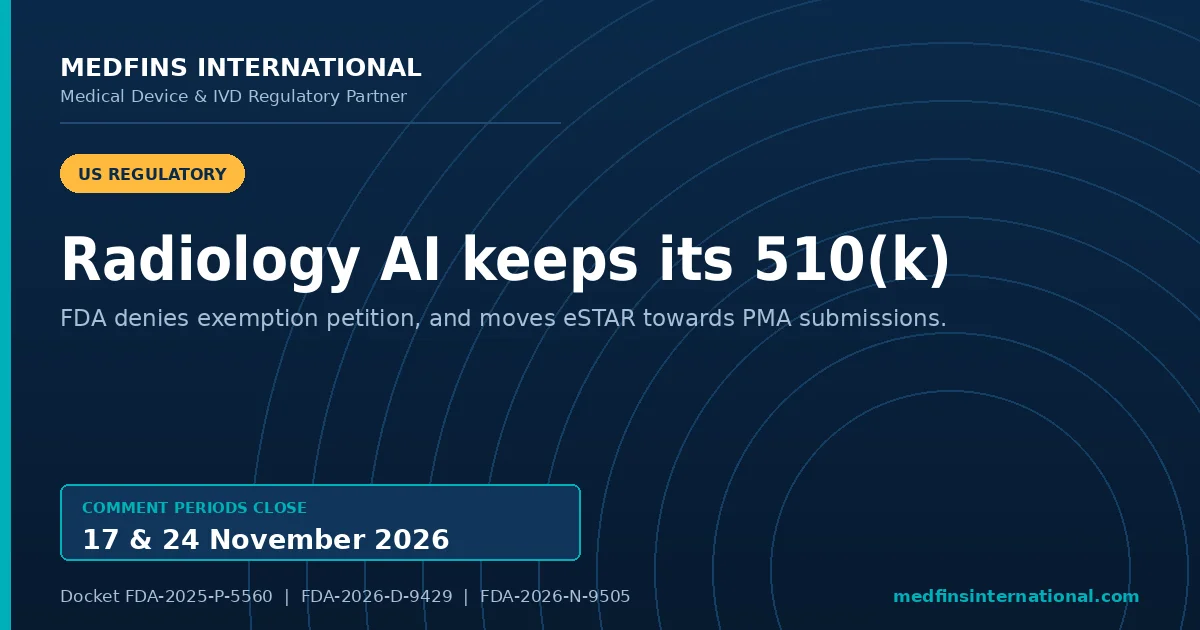
Three FDA actions in the past ten days matter to anyone with a United States submission in progress. One closes a question about artificial intelligence software. Two open comment periods that end in November.
1. Radiology CAD and CADt software stays inside 510(k)
On 17 September 2026 FDA published a final order denying a citizen petition that had asked for a partial exemption from premarket notification for radiology computer-aided detection and diagnosis software and computer-aided triage and notification software. The order took effect the same day. The docket is FDA-2025-P-5560. The petition was filed on 22 October 2025 by Nancy Stade, J.D., on behalf of Harrison.ai.
The petition did not ask for a blanket exemption. It proposed exempting these devices where the manufacturer already held prior 510(k) clearances and had a post-market surveillance plan in place. FDA rejected that structure, concluding that the information presented did not demonstrate that premarket notification is not necessary to assure the safety and effectiveness of the devices concerned.
The classifications that remain subject to 510(k) are:
- 21 CFR 892.2060, radiological computer-assisted diagnostic software for lesions suspicious of cancer, product code POK
- 21 CFR 892.2070, medical image analyzer, product code MYN
- 21 CFR 892.2080, radiological computer aided triage and notification software, product codes QAS and QFM
- 21 CFR 892.2090, radiological computer-assisted detection and diagnosis software, product codes QBS and QDQ
For software developers, including the growing number of Indian imaging AI companies targeting the United States, the practical reading is that an established clearance history does not shorten the route for the next product in the family. Each device still needs a predicate, a substantial equivalence argument and standalone performance data. Where the product is expected to be retrained or updated after clearance, that change strategy belongs inside the submission rather than in a post-market plan offered as a substitute for review.
2. eSTAR is being extended to PMAs, in draft
On 18 September 2026 FDA published a draft guidance, “Electronic Submission Template for Medical Device Premarket Approval Applications (PMAs)”. The docket is FDA-2026-D-9429 and comments close on 17 November 2026.
The draft covers original PMAs, panel-track supplements, 180-day supplements, real-time supplements, and 30-day notices and 135-day supplements. It is a preparatory document. The draft does not itself make electronic submission compulsory for PMAs. FDA states that the finalised guidance will set the standards, the timetable, and the criteria for waivers and exemptions.
The current position is worth restating, because it is frequently misremembered. eSTAR is already mandatory for 510(k) and De Novo submissions to CDRH or CBER unless specifically exempted, and for dual 510(k) and CLIA waiver IVD submissions. For PMAs it remains voluntary today. This draft is the step towards changing that.
Two operational points follow. First, check the template version before you start compiling. As of 21 September 2026 the non-IVD and IVD eSTARs are at version 7.1, and they now incorporate the content of the Human Factors content guidance published on 29 May 2026 and effective from 1 August 2026. A submission assembled in an older template invites a technical screening problem. Second, if your organisation has a PMA route ahead, this is the comment window in which to raise waiver criteria and transition length.
3. Draft guidance on robotically-assisted surgical devices
On 25 September 2026 FDA published a draft guidance, “Robotically-Assisted Surgical Devices, Premarket Submissions”. The docket is FDA-2026-N-9505 and comments close on 24 November 2026.
The draft addresses teleoperated, software-controlled systems that integrate robotic technologies to assist a surgeon, across open surgery, minimally invasive procedures and endoluminal applications. It covers non-clinical testing, clinical evaluation and what FDA expects to see in the premarket submission. Like all draft guidance it is non-binding and states FDA’s current thinking.
FDA is also holding a public workshop, “Evaluating Benefit-Risk in Robotic Medical Devices with Autonomous or Remote Teleoperation Capabilities”, on 2 and 3 December 2026, from 10:00 to 16:00 Eastern Time each day. It is a hybrid event at the White Oak campus in Silver Spring, Maryland, with a webcast. In-person registration closes on 23 November 2026 or when capacity is reached, and virtual registration stays open after that. Registration is free. FDA’s contact address for the event is CDRHRoboticsWorkshop@fda.hhs.gov.
Autonomy and remote teleoperation are the unresolved areas here. If your roadmap includes either, the workshop and the comment period are the two places where the expectations for the next five years are being set.
What this means for manufacturers
- If you make radiology AI or triage software, plan on a 510(k) for every device in the family. Budget the predicate search, the reader or standalone performance study and the review time accordingly.
- Do not build a regulatory strategy around a post-market surveillance commitment replacing premarket review. FDA has now declined that trade in writing.
- Download a fresh eSTAR before compiling any 510(k) or De Novo. Version 7.1 as of 21 September 2026 carries the human factors content that took effect on 1 August 2026.
- If a PMA is on your roadmap, read the draft and comment by 17 November 2026. Waiver criteria and transition length are still open.
- If you work in robotic or teleoperated surgical systems, comment by 24 November 2026 and register for the December workshop by 23 November 2026.
- Check that your quality system already produces the evidence these submissions ask for. Design controls, human factors records and software lifecycle documentation are the usual gap, not the submission form.
Our US FDA 510(k) submission support covers predicate strategy, eSTAR compilation and response to Additional Information requests. The underlying quality system work sits under ISO 13485:2016, and for manufacturers holding several markets at once the MDSAP route reduces duplicated audits. For Indian manufacturers building both a domestic and a United States position, the CDSCO manufacturing licence scope is set out separately. A full list is on our services page.
Frequently asked questions
Does the denial mean radiology AI will never be exempt from 510(k)?
No. It means this petition, on this record, was denied. FDA’s conclusion was that the information presented did not demonstrate that premarket notification is unnecessary for these devices. A different petition on a different evidence base is not foreclosed, but nothing in the order suggests an exemption is imminent.
We already have three clearances for similar software. Does the fourth get a lighter review?
Prior clearances give you a credible predicate and a body of validated methods, which usually shortens preparation. They do not remove the submission requirement. That was precisely the relief the petition sought and did not get.
Should we submit our PMA using eSTAR now?
You may, because voluntary use is available, and doing so gives your team the experience before it becomes compulsory. If the schedule is tight and your team has no eSTAR experience on a PMA, weigh that learning curve against the review clock.
Is the robotics draft guidance in force?
No. Draft guidance represents FDA’s current thinking and is not binding on FDA or on industry. It is, in practice, what reviewers will read, so aligning to it early is sensible.
How do we submit comments to FDA?
Through the relevant docket on regulations.gov, quoting the docket number, before the closing date. FDA-2026-D-9429 closes on 17 November 2026 and FDA-2026-N-9505 closes on 24 November 2026.
Sources
- FDA final order, Medical Devices; Exemption from Premarket Notification: Radiology Computer-Aided Detection and/or Diagnosis Devices, 17 September 2026, docket FDA-2025-P-5560.
- FDA draft guidance notice, Electronic Submission Template for Medical Device Premarket Approval Applications (PMAs), 18 September 2026, docket FDA-2026-D-9429.
- FDA draft guidance, Electronic Submission Template for Premarket Approval Applications.
- FDA draft guidance notice, Robotically-Assisted Surgical Devices, Premarket Submissions, 25 September 2026, docket FDA-2026-N-9505.
- FDA draft guidance, Robotically-Assisted Surgical Devices, Premarket Submissions.
- FDA public workshop, Evaluating Benefit-Risk in Robotic Medical Devices with Autonomous or Remote Teleoperation Capabilities, 2 to 3 December 2026.
- FDA eSTAR Program page, updated 21 September 2026.
- FDA CDRH News and Updates.