Form MD-14, the application for a CDSCO import licence, is a short online form. The file behind it is not. CDSCO’s own checklist for a fresh application runs to twelve sections, and the device master file inside it has twenty sub-headings. This is where import applications slow down: documents prepared to another regulator’s format rather than to the one CDSCO asks for.
This guide walks through that checklist section by section — what each document must show, and where files commonly fall short. It assumes you already know an import licence is your route. If you are not sure, start with our overview of which CDSCO licence applies, or see our CDSCO import licence service for how we handle the whole application.
Who files, and where
An overseas manufacturer cannot file Form MD-14 itself. Rule 34 of the Medical Devices Rules, 2017 requires the application to come from an authorised agent — defined in Rule 3(f) as the person or firm the overseas manufacturer appoints by power of attorney to import its devices into India. That agent must hold a manufacturing licence or a wholesale licence, and CDSCO’s FAQ confirms that a registration certificate in Form MD-42 also qualifies (Q90).
The application goes online — through CDSCO’s Medical Devices Online portal or the National Single Window System (FAQ Q8) — to the Central Licensing Authority, whatever the risk class of the device. Rule 36 allows the authority up to nine months from the date of application to grant the licence in Form MD-15 or reject it.
Two answers in the FAQ shape the commercial arrangement before a single document is written. The same product, from the same legal and actual manufacturer, can be imported by more than one authorised agent (Q94). And changing your agent later means a fresh import licence, not an amendment (Q104). Choose your Indian authorised agent as a long-term decision.
The fresh application checklist, section by section
CDSCO publishes a separate checklist for each type of MD-14 application. Checklist A, for a fresh application, has twelve sections.
Sections 1–3: covering letter, Form MD-14 and fee challan
Fees are set in the Second Schedule and charged per overseas manufacturing site and per device, according to risk class. Two FAQ answers matter here: a separate fee is payable for each brand of a device (Q15), and the Rules make no provision for refunds if you withdraw (Q14). Settle the product list and brand names before you pay.
Section 4: power of attorney
The power of attorney from the overseas manufacturer, with the authorised agent’s undertaking in the format of Part I of the Fourth Schedule. The checklist accepts three forms of authentication: by a Magistrate of First Class in India, by the Indian Embassy in the country of origin, or by an equivalent authority through apostille. A document that is only notarised abroad, with no apostille or embassy authentication, is not one of the three.
Sections 5–6: the authorised agent’s licence and constitution
A copy of the agent’s wholesale licence, manufacturing licence or MD-42 certificate, and details of the agent’s constitution — proprietorship, partnership, LLP or company.
Section 7: regulatory certificates
- 7.1 — free sale certificate or marketing authorisation from the national regulator of the country of origin, if any, notarised.
- 7.2 — free sale certificate or marketing authorisation from a regulator in the USA, UK, EU, Canada, Japan or Australia, notarised.
- 7.3 — the overseas site’s registration with the competent authority in the country of origin, notarised.
- 7.4 — the latest inspection or audit report by a competent authority from the last three years, if any.
The FAQ adds two conditions that catch applicants. The free sale certificate must name both the legal manufacturer and the actual manufacturer (Q108). And a certificate of exportability — one showing a product may be exported, not that it is freely sold at home — is not accepted as a free sale certificate (Q111).
Section 8: quality certificates for the actual manufacturing site
A certificate supporting the quality management system; the full quality assurance, CE type-examination, CE product quality assurance or CE design certificate, as applicable (both notarised); and the manufacturer’s declaration of conformity. The heading matters: these certificates must cover the actual manufacturing site. A legal manufacturer’s ISO 13485 certificate that covers only its head office answers the wrong question.
Section 9: plant master file
A plant master file for the overseas site, prepared to Appendix I of the Fourth Schedule (FAQ Q9). Write it to that structure, not as a relabelled site document from another market.
Section 10: device master file
Prepared to Appendix II of the Fourth Schedule. The checklist breaks it into twenty parts, which fall into four groups:
- What the device is: executive summary; device description; justification for the grouping used in the application; specification including variants and accessories; substantial equivalence to a predicate device or a previous generation of the device.
- How it is labelled and made: labels and instructions for use; design and manufacturing information.
- Why it is safe and performs: essential principles checklist; risk analysis and control summary; verification and validation; and, where they apply, biocompatibility, medicinal substance data, TSE/BSE safety, sterilisation validation, software verification and validation, animal studies, stability data (real-time and accelerated) for the claimed shelf life, and clinical evidence.
- How it has performed on the market: post-marketing surveillance (vigilance) data, and batch release certificates or certificates of analysis for at least three consecutive batches, or a software version release certificate.
Two details save queries. Only accessories and components defined in the device master file as part of the main device, and shown in its instructions for use, should be listed in the application (FAQ Q64). And for shelf life, CDSCO expects real-time ageing data; accelerated data can support a provisional claim only if the real-time study is already running and its results are submitted when complete (Q34, Q37).
Sections 11–12: other documents and investigational devices
Any other supporting documents, and — for an investigational medical device — a copy of the permission in Form MD-27.
Where clinical data comes in
Rule 36 links the clinical data you need to where the device is already approved. The text published on CDSCO’s site says:
- if a free sale certificate has already been issued by the regulator of Australia, Canada, Japan, the European Union or the United States, the licence is granted without a clinical investigation (Rule 36(3));
- for devices from other countries, Class C and D may be licensed after safety and effectiveness are established through clinical investigation in India (Rule 36(4));
- for devices from other countries, Class A and B may be licensed on published safety and performance data or a clinical investigation in the country of origin, with a free sale certificate from that country (Rule 36(5)).
Note that CDSCO’s checklist names six jurisdictions for the second free sale certificate, including the UK, while Rule 36(3) as published names five. If your reference approval is UK-only, confirm the position with CDSCO before you file. An investigational device or a new in vitro diagnostic needs permission in Form MD-27 or MD-29 before any import licence (Rule 36(6)).
Classify from the Indian rules, not from your EU or US class. Where the Indian class differs from the class in other IMDRF jurisdictions, the FAQ says CDSCO may apply the higher one (Q93).
After the licence: products, sites and consignments
Adding products or sites. A further device from the same site is added by an endorsement application (checklist B): a device master file, current certificates, and an undertaking from the manufacturer that the plant master file has not changed in any major way — or an updated plant master file if it has. Another site for the same device needs the full fee and documents (Rule 34(4)). An endorsement is valid for as long as the base licence (FAQ Q56).
Changes. Major changes listed in the Sixth Schedule need CDSCO’s prior approval; the authority is to decide within 60 days, after which the change is deemed approved (Rule 38). Minor changes are notified within 30 days of taking effect. A change in the location of the overseas manufacturer or its site needs a fresh licence (FAQ Q92).
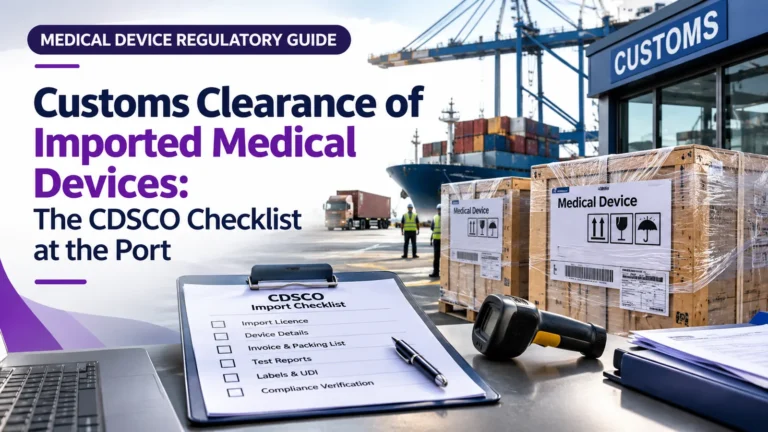
Consignments. Licensed devices can enter only through ports notified under the Drugs Rules (FAQ Q106), and can then be stocked at any of the importer’s registered warehouses (Q107). India-specific details — import licence number, importer’s name and address, actual manufacturing site and date of manufacture — can be added by sticker where they are not printed (Rule 44(n), Q99). Rule 47 also sets a minimum residual shelf life on the date of import: 40% for devices with a total shelf life under 90 days, 50% for 90 days to one year, and 60% for more than one year. Our customs clearance checklist covers the port in detail.
Overseas action. The licensee must tell CDSCO within 15 days of any administrative action abroad, such as a market withdrawal or cancellation of authorisation (Rule 38).
Retention every five years
An MD-15 licence stays valid in perpetuity, provided the authorised agent pays the licence retention fee for each overseas site and each licensed device after every five years (Rule 37). Late payment is allowed for 90 days with a late fee of two per cent a month; after that the licence is deemed cancelled. The retention checklist (checklist C) asks for five years of post-marketing surveillance data — complaints, recalls and corrective actions — plus current certificates and undertakings that the device and plant master files and the power of attorney have not changed. A retention application filed on time with the fee keeps the licence valid while it is processed (FAQ Q141).
Where this goes wrong
A power of attorney authenticated for another market. Notarised in the manufacturer’s country and nothing more is not one of CDSCO’s three accepted forms. Ask for apostille or embassy authentication at the start.
A free sale certificate that names only the legal manufacturer. The actual manufacturing site must appear too. A certificate of exportability will not do.
Quality certificates for the wrong site. An ISO 13485 certificate covering the head office, or a CE certificate that does not list the actual factory, leaves section 8 unanswered.
A device master file copied from another dossier. An EU technical file or a US 510(k) holds most of the content, but CDSCO reviews against Appendix II. Re-order and re-title it, and add what Appendix II asks for that the other dossier did not, such as consecutive-batch release certificates.
Brands and grouping settled late. Each brand attracts a fee, and fees are not refunded. Fix the product list, brands and grouping justification before the challan is paid.
A shelf-life claim the data does not support — and stock that is too old. Accelerated data alone supports only a provisional claim. And even with a licence, a consignment below the residual shelf-life threshold in Rule 47 will not be allowed in.
Treating the agent or the retention date as administration. A new agent means a new licence, and a missed retention date has a 90-day window before the licence is deemed cancelled. Put both in the compliance calendar with an owner’s name.
Frequently asked questions
What documents are required for a CDSCO import licence?
Under CDSCO’s checklist for a fresh Form MD-14 application: covering letter, application and fee challan; an authenticated power of attorney; the authorised agent’s licence and constitution details; free sale certificates and site registration; quality certificates for the actual manufacturing site and a declaration of conformity; a plant master file; and a device master file.
Can an overseas manufacturer apply for a CDSCO import licence directly?
No. The application is made by an Indian authorised agent holding a manufacturing licence, a wholesale licence or a registration certificate in Form MD-42.
Does the power of attorney need an apostille?
It needs one of three forms of authentication: by a First Class Magistrate in India, by the Indian Embassy in the country of origin, or by an equivalent authority through apostille.
Is a CE certificate enough instead of a free sale certificate?
No. The checklist lists CE certificates under quality certificates and asks separately for a notarised free sale certificate or marketing authorisation.
How long does a CDSCO import licence take?
Rule 36 allows the Central Licensing Authority up to nine months from the date of application. A complete, consistent file is the part within your control.
Does an MD-15 import licence expire?
No. It remains valid until cancelled or surrendered, provided the retention fee is paid for each site and each device after every five years.
Talk to us about your import file
Medfins has delivered 175+ regulatory projects covering 250+ products for 100+ clients. We check an import file against CDSCO’s checklist before it is filed, prepare the plant and device master files, and can act as your Indian authorised agent. See our CDSCO import licence service or contact our team.
Official sources: CDSCO checklist for Form MD-14 · CDSCO FAQ on Medical Devices