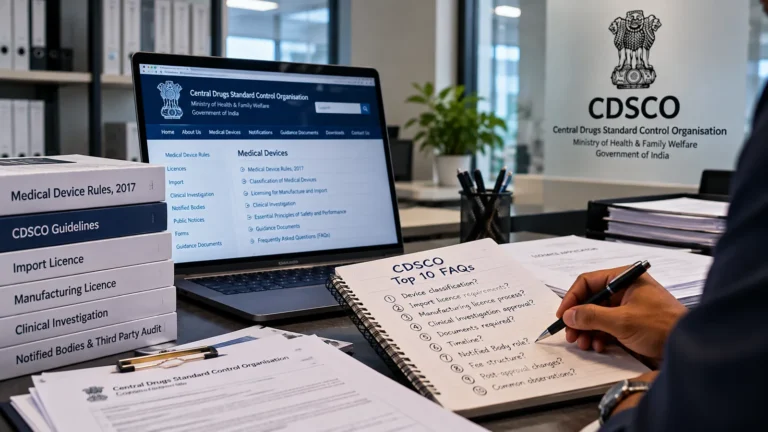
The import licence took nine months. The first consignment lands in Chennai, the clearing agent files the bill of entry, and the goods sit. Customs wants to see the labels, the batch certificates and proof of where the devices will be stored — and it wants the label to match the licence, line by line.
Since 3 September 2026, that is the expected routine. CBIC Circular No. 40/2026-Customs directs Customs officers to verify a set of CDSCO-supplied documentary checklists before granting out-of-charge — the release of goods from Customs — for imports of cosmetics, drugs and medical devices. This guide explains what the medical device checklists ask for, why the label is where most consignments stumble, and how to prepare a shipment so it clears first time.
Why Customs is now checking CDSCO documents
Import of medical devices is regulated by CDSCO under the Drugs and Cosmetics Act, 1940 and the Medical Devices Rules, 2017. Customs has always been the point where goods physically enter the country. What the circular changes is the method: until CDSCO’s licences and permissions are integrated into SWIFT 2.0, Customs’ single-window clearance system, officers are to check the required documents manually before release and exercise due diligence while doing so.
The checklists themselves were provided by CDSCO and cover seven product categories. Three of them concern medical devices:
- Checklist V — medical devices, including in vitro diagnostic (IVD) devices, imported for sale.
- Checklist VI — devices imported for clinical investigation, testing, evaluation, demonstration or training, investigational devices, and small quantities for personal use.
- Checklist VII — raw materials and components imported by a licensed device manufacturer.
The circular also asks Customs field offices to tell the trade, by public notice, to upload the required documents on e-SANCHIT, the online document-upload facility used with the bill of entry, to speed up clearance. If a discrepancy or doubt arises, officers are to refer it to the CDSCO port office.
Before the shipment: the licence itself
Nothing in the circular replaces the import licence. Under Rule 34 of the Medical Devices Rules, an import licence is applied for in Form MD-14 by the overseas manufacturer’s Indian authorised agent, who must hold a manufacturing licence, a wholesale licence or a Form MD-42 registration certificate. Under Rule 36(1), the Central Licensing Authority grants the licence in Form MD-15, or rejects the application, within nine months of the date of application. Under Rule 37, the licence remains valid in perpetuity unless cancelled or surrendered, provided the licence retention fee is paid after every five years.
The circular’s starting point is that this licence exists and that every shipment matches it. For Class A devices that are non-sterile and non-measuring, the checklist asks for the registration number instead.
Checklist V: what Customs checks on a commercial consignment
Checklist V has nine items. Each document is to be self-certified by the importer.
- Import licence. A copy of the Form MD-15 licence issued by CDSCO, or the registration number for non-sterile, non-measuring Class A devices.
- Invoice. The invoice must name the item and match the MD-15 licence, including pack size for finished products.
- Packing list.
- Certificate of country of origin.
- Labels and markings. The labels must match the MD-15 licence for item name, licence number and importer name and address, and must also show the manufacturer’s name and address, storage conditions, batch, lot or serial number, date of manufacture and date of expiry.
- Residual shelf life. For items with a shelf life, residual shelf life is calculated from the date of import. The minimum is at least 40% for a 90-day shelf life, at least 50% for a shelf life between 90 and 365 days, and at least 60% for a shelf life over 365 days.
- Batch quality certificate. A certificate of analysis or quality certificate for each batch, matching the MD-15 licence.
- Storage premises. A copy of the licence for the premises where the devices will be stored.
- Condition of goods. An undertaking from the importer that the packaging is not damaged, broken or destroyed and the contents have not deteriorated.
Most of this list restates obligations that already existed. Rule 44(n) of the Medical Devices Rules already requires imported devices to carry, by stickering where not already printed, the import licence number, the name and address of the importer, the address of the actual manufacturing premises and the date of manufacture. What is new is that the match is now checked document by document, before release, at the port.
Checklists VI and VII: non-commercial imports and components
Checklist VI covers devices brought in for clinical investigation, test, evaluation, demonstration or training, investigational devices, and small quantities for personal use. Customs checks a copy of the import licence in Form MD-17 or MD-19, or the permission in Form MD-21, plus the invoice, packing list and certificate of origin. The invoice must show the item name and a quantity that matches the licence or permission. Under Rule 40, the test licence is applied for in Form MD-16 and, under Rule 41, granted in Form MD-17, which remains in force for three years unless cancelled earlier.
Checklist VII covers raw materials and components imported for device manufacture. Customs checks a copy of the manufacturing licence — Form MD-5 for Class A and B devices, Form MD-9 for Class C and D — with the invoice, packing list and certificate of origin.
Where this goes wrong
The invoice describes the product differently from the licence. The overseas factory invoices by its catalogue name or internal code. The MD-15 licence lists the device by the name approved by CDSCO. Checklist V asks for the invoice to match the licence, including pack size. Send the factory the exact device names and pack sizes from your MD-15 and ask for invoices to use them.
A pack size that was never endorsed. A new pack configuration — a box of 50 where the licence covers a box of 10 — can look like a commercial detail. Against a checklist that matches pack size, it is a discrepancy. Check the licence before the order is placed, not when the goods are at the port.
Stickers applied after arrival. Rule 44(n) particulars are Indian details that the overseas factory will not print by default. If the plan is to sticker in the Indian warehouse, the labels Customs inspects will not show the import licence number or importer details. Arrange compliant stickering before despatch, or confirm with your clearing agent how the port will treat goods stickered under bond.
Short-dated stock. Distributors sometimes accept older batches at a discount. Under Checklist V, a device with a two-year shelf life must arrive with at least 60% of that life remaining. Work out the minimum expiry date for each product before goods leave the factory, and write it into the purchase order.
A certificate of analysis that does not match the batch. The certificate must cover each batch in the consignment. A generic quality certificate, or one for a different lot, does not meet item 7. Ask for batch-specific certificates with every shipment.
The storage premises are not licensed. Item 8 asks for the licence of the premises where the devices will be stored. If you have moved warehouse, or are using a third-party warehouse, check that the premises named in your MD-42 certificate, wholesale licence or manufacturing licence is the one the goods are going to.
Documents uploaded late, or not at all. The circular asks for documents on e-SANCHIT to speed up clearance. Agree with your clearing agent who uploads what, and have the full set ready before the vessel or flight arrives.
A pre-shipment check you can run
Before each consignment leaves the factory, one person on the Indian side should hold the MD-15 licence in one hand and the draft invoice, label proof and batch certificate in the other, and confirm five things:
- the device name and pack size on the invoice match the licence;
- the label shows the licence number, importer name and address, manufacturer, storage conditions, batch or serial number, manufacture date and expiry date;
- residual shelf life on arrival will meet the 40/50/60% thresholds;
- a certificate of analysis exists for every batch;
- the destination warehouse is the licensed premises.
Ten minutes at the factory end saves days at the port.
Frequently asked questions
Does CBIC Circular 40/2026 change the import licence requirement?
No. It does not create a new licence. It tells Customs to verify, before release, that the documents required under the Drugs and Cosmetics Act, 1940 and the rules made under it are in order, using checklists supplied by CDSCO.
Do Class A medical devices need an import licence to clear Customs?
For Class A devices that are non-sterile and non-measuring, Checklist V asks for the registration number rather than an MD-15 import licence. Other Class A devices, and all Class B, C and D devices, need the MD-15 licence.
What residual shelf life do imported medical devices need?
Calculated from the date of import: at least 40% for a 90-day shelf life, at least 50% for a shelf life between 90 and 365 days, and at least 60% for a shelf life over 365 days.
Can labels be stickered after the goods arrive in India?
Rule 44(n) allows the Indian particulars to be applied by stickering where they are not already printed. But Checklist V asks Customs to check the labels at clearance, so the stickering needs to be done before the goods are presented, or handled in a way your port accepts.
What happens if Customs finds a discrepancy?
The circular tells officers to refer any discrepancy or doubt to the CDSCO port office. In practice that means the consignment waits while the point is resolved, which is why the documents should be checked before despatch.
Medfins prepares and manages CDSCO import licence applications from Form MD-14 to MD-15, and helps importers set up labelling, documentation and shipment checks so consignments clear first time. If your first shipment is due, or a consignment is held at the port, contact our team or see our CDSCO import licence services.