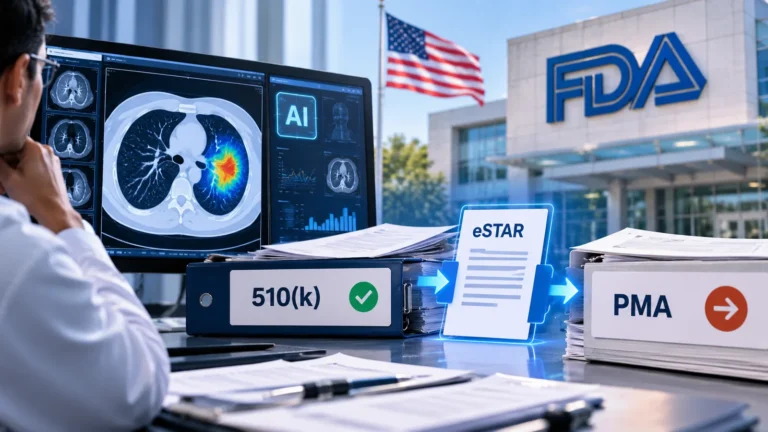
Getting a medical device into the United States usually comes down to one submission: the 510(k). It is the pathway most devices take to reach the US market, and it is also where many manufacturers lose the most time — not because the science is hard, but because the submission is built wrong before it is ever filed.
This guide walks through what a 510(k) actually requires in 2026, what it costs, how long it takes, and the specific mistakes that turn a three-month clearance into a nine-month one.
What is a 510(k) submission?
A 510(k) is a premarket notification filed with the US Food and Drug Administration to demonstrate that your device is substantially equivalent to a device already legally marketed in the United States. That reference device is called the predicate.
The word most people misread is “equivalent”. The FDA is not asking whether your device is identical. It is asking whether your device has the same intended use and the same technological characteristics as the predicate — or, where the technology differs, whether you can show the differences do not raise new questions of safety and effectiveness.
A 510(k) is a clearance, not an approval. Devices that go through Premarket Approval (PMA) are “approved”. Devices cleared under 510(k) are “cleared”. Using the wrong word in your marketing material is a compliance issue in itself.
Does your device actually need a 510(k)?
Several routes exist, and picking the wrong one costs months:
- 510(k) exempt — most Class I devices and a subset of Class II devices are exempt from premarket notification. You still need establishment registration, device listing and quality system compliance, but no submission.
- 510(k) — the majority of Class II devices, where a suitable predicate exists.
- De Novo — for a genuinely novel low-to-moderate risk device with no predicate. Filing a 510(k) with no valid predicate and hoping it passes is one of the most expensive mistakes a manufacturer can make.
- PMA — Class III devices, and a substantially heavier evidentiary burden.
Classification is determined by the device’s intended use and indications for use, and is found through the FDA’s product classification database against a three-letter product code and a regulation number. Get the product code wrong and everything downstream is wrong.
The three types of 510(k)
| Type | When it applies | Typical use |
|---|---|---|
| Traditional | Default route for a new device or a significant change to your own cleared device | Most first-time submissions |
| Special | A modification to your own legally marketed device where design controls can verify the change | Fast route for design changes |
| Abbreviated | Where conformance to recognised standards, special controls or FDA guidance can carry the demonstration | Well-characterised device types |
There is also the Safety and Performance Based Pathway, which lets certain well-understood device types demonstrate equivalence against FDA-identified performance criteria rather than direct comparison to a specific predicate.
Choosing a predicate: the step that decides everything
In our experience this single decision determines the outcome of a submission more than any other. A weak predicate produces an Additional Information request that no amount of good testing will rescue.
A predicate must be:
- Legally marketed — cleared through 510(k), or pre-amendments, or reclassified. Not a device withdrawn for safety reasons.
- The same intended use — compared on the indications for use statement, word by word. Small differences in wording create large differences in review.
- Technologically comparable — same fundamental design, materials, energy source and operating principle, or defensible differences.
Common predicate errors we see in submissions that come to us for rescue: selecting a predicate whose indications are broader than the device can support; selecting a predicate that has since been recalled; and “split predicates” — borrowing intended use from one device and technology from another, which the FDA does not accept.
eSTAR: electronic submission is mandatory
Since 1 October 2023, all 510(k) submissions must be filed electronically using the FDA’s eSTAR template, unless specifically exempted. Paper and eCopy submissions are no longer the norm.
eSTAR is a structured, interactive PDF form. It matters for two practical reasons:
- It performs an automated completeness check. A submission with missing mandatory fields cannot be finalised, which has largely eliminated the old Refuse to Accept failures caused by simple omissions.
- It forces structure. You cannot bury a weak biocompatibility rationale in an appendix and hope it passes unnoticed.
Submissions are filed through the CDRH Customer Collaboration Portal. FDA periodically updates the template, so always download the current version rather than reusing an older file.
What goes into the submission
A Traditional 510(k) built in eSTAR will typically cover:
- Device description, including all models, accessories and configurations
- Indications for Use statement (Form FDA 3881)
- Substantial equivalence discussion and predicate comparison table
- Proposed labelling, instructions for use and packaging
- Biocompatibility evaluation per ISO 10993 for patient-contacting devices
- Sterilisation, shelf life and packaging validation where applicable
- Software documentation per the FDA’s premarket software guidance, plus cybersecurity documentation where the device is network-capable
- Electrical safety and EMC — typically the IEC 60601 series
- Performance testing — bench, and animal or clinical where bench data cannot answer the question
- Risk management file per ISO 14971
- Truthful and Accurate Statement, and Financial Certification where clinical data is included
Most 510(k)s do not require clinical data. Where they do, it is usually because the technological differences from the predicate cannot be resolved by bench testing alone.
Timelines: what “90 days” actually means
The FDA’s MDUFA performance goal for a 510(k) decision is 90 FDA days. The critical detail is that FDA days are not calendar days — the clock stops whenever the submission is on hold with you.
- Acceptance review — within 15 days FDA confirms the submission meets minimum threshold criteria. A failure here is a Refuse to Accept (RTA) decision, and you have 180 calendar days to fix the cited deficiencies.
- Substantive review — the reviewer works through the technical content, and may use Interactive Review to resolve small questions by email without stopping the clock.
- Additional Information (AI) request — the clock stops entirely. You have 180 calendar days to respond. This is where most timelines are lost: a submission that takes four months to answer has added four months, not four days.
- Decision — Substantially Equivalent (SE) and cleared, or Not Substantially Equivalent (NSE).
If no decision is reached by 100 FDA days, the FDA issues a Missed MDUFA Communication describing the outstanding issues.
Plan for four to nine months from filing to clearance for a well-prepared first submission. Anyone promising 90 calendar days is describing the goal, not the practice.
What a 510(k) costs in FY2026
FDA user fees for the fiscal year running 1 October 2025 to 30 September 2026:
| Fee | Standard | Small business |
|---|---|---|
| 510(k) submission | $26,067 | $6,517 |
| Annual establishment registration | $11,423 | $11,423 (no reduction) |
The Small Business Determination is worth pursuing. If your organisation had gross receipts or sales of no more than $100 million in its most recent tax year, you may qualify — reducing the submission fee by roughly 75%. Foreign manufacturers apply using their national taxing authority’s certification. Apply for the SBD before you submit; it cannot be applied retroactively to a fee already paid.
Beyond FDA fees, budget for testing — biocompatibility, electrical safety, EMC, sterilisation and shelf-life validation routinely exceed the user fee itself.
What foreign manufacturers must have in place
For a manufacturer outside the United States, clearance alone does not permit sale. Three additional obligations apply:
- US Agent — every foreign establishment must designate a US Agent, physically located in the United States, who acts as the FDA’s communication channel. The US Agent is not the same as an importer or distributor, though one entity can hold multiple roles.
- Establishment registration and device listing — renewed annually, with the registration fee above payable each year.
- Quality system compliance — see below.
The 2026 change you cannot ignore: QMSR
On 2 February 2026, the FDA’s Quality Management System Regulation (QMSR) took effect, amending 21 CFR Part 820. It incorporates ISO 13485:2016 by reference, together with Clause 3 of ISO 9000:2015.
For manufacturers already certified to ISO 13485, this is largely good news — US quality system requirements now align with the standard you already run. But alignment is not equivalence. Where ISO 13485 and the Federal Food, Drug, and Cosmetic Act conflict, the FD&C Act controls, and QMSR retains US-specific requirements that ISO 13485 does not cover.
The FDA has also retired the Quality System Inspection Technique (QSIT) as its inspection model. If your internal audit programme and inspection readiness were built around QSIT, they are now out of date.
If you hold ISO 13485:2016 certification and assume you are automatically QMSR-compliant, that assumption needs testing against a formal gap assessment.
Five reasons 510(k) submissions get delayed
- A predicate that cannot carry the intended use. No amount of testing fixes this.
- Indications for Use drafted to be broad. Ambitious wording invites an NSE. Claim what your evidence supports.
- Biocompatibility handled as paperwork. ISO 10993-1 requires an evaluation and a rationale, not a stack of certificates.
- Software and cybersecurity documentation prepared late. For connected devices this is now among the most common sources of AI requests.
- Slow AI responses. The clock is stopped, so the delay is entirely yours. A complete response within weeks rather than months is the single biggest lever on total time to market.
How Medfins International supports your 510(k)
We work with manufacturers in India and internationally across the full pathway: device classification and product code determination, predicate search and substantial equivalence strategy, gap assessment against testing requirements, eSTAR compilation and submission through the CDRH portal, FDA query and AI response management, US Agent services, establishment registration and listing, and QMSR and ISO 13485:2016 readiness.
Our approach is deliberately front-loaded. The work that determines whether a submission clears in one round happens before anything is filed.
Frequently asked questions
How long does FDA 510(k) clearance take?
The FDA’s performance goal is 90 FDA days, but FDA days exclude time when the submission is on hold with the manufacturer. In practice, budget four to nine months from submission to clearance for a well-prepared file. A single Additional Information request commonly adds two to four months, depending on how quickly you respond.
How much does a 510(k) submission cost in 2026?
The FY2026 FDA user fee is $26,067 for a standard submission and $6,517 for a qualified small business, plus an annual establishment registration fee of $11,423. Testing, consulting and documentation costs are separate and frequently exceed the user fee.
Can an Indian manufacturer file a 510(k) directly?
Yes. A foreign manufacturer can hold its own 510(k) clearance. You must, however, designate a US Agent located in the United States, and complete establishment registration and device listing before marketing the device.
What is the difference between 510(k) clearance and FDA approval?
They are different regulatory outcomes. A 510(k) results in clearance, based on substantial equivalence to a legally marketed predicate device. Approval applies to Class III devices that go through Premarket Approval, which requires valid scientific evidence of safety and effectiveness. Describing a cleared device as “FDA approved” is a labelling violation.
Does ISO 13485 certification mean I comply with FDA quality requirements?
Not automatically. Since 2 February 2026 the FDA’s QMSR incorporates ISO 13485:2016 by reference, which brings the two much closer together. But QMSR retains US-specific requirements, and where ISO 13485 conflicts with the FD&C Act, the Act prevails. A formal gap assessment is the only reliable way to confirm your position.
What happens if my device has no predicate?
If no legally marketed equivalent device exists, the 510(k) pathway is not available. A low-to-moderate risk device with no predicate should generally go through the De Novo classification request. Filing a 510(k) without a valid predicate typically results in a Not Substantially Equivalent decision and lost months.
Planning a US market entry?
If you are preparing a 510(k) — or you have received an Additional Information request and need it answered properly — we are happy to review your device and give you an honest read on the pathway, the evidence you will need, and a realistic timeline.
Write to sales@medfinsinternational.com or call +91 8527048221.