
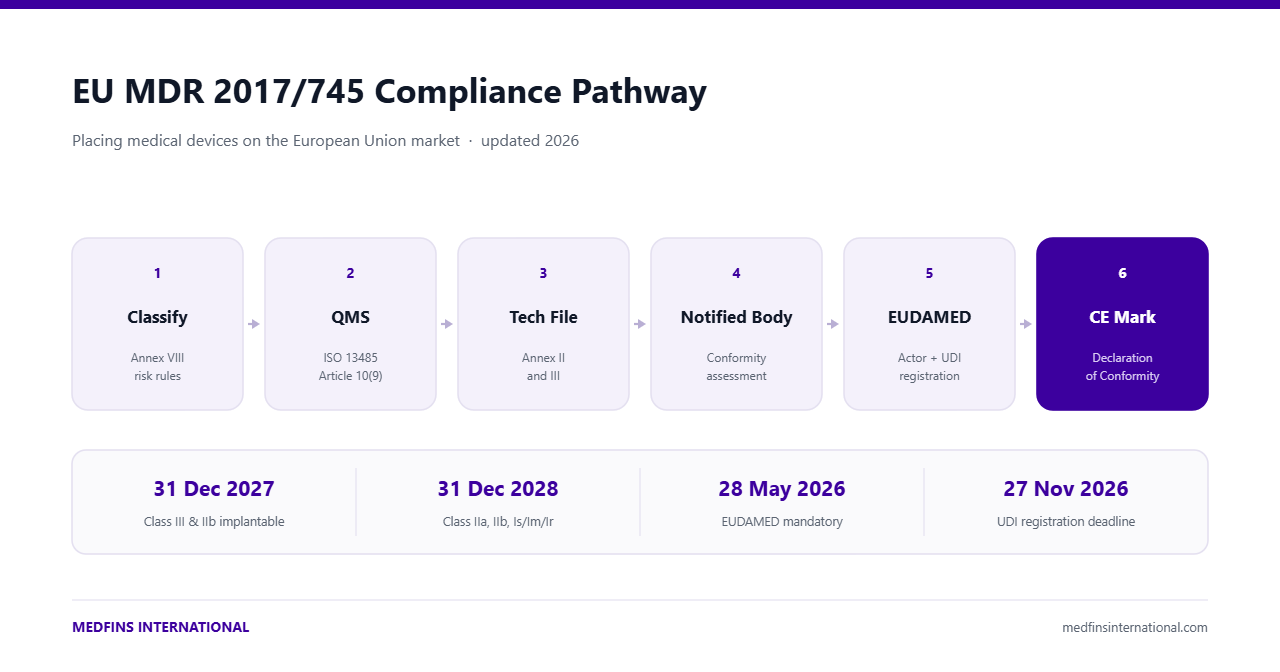
If you manufacture medical devices outside Europe and sell into the EU, 2026 is the year the grace period stops being comfortable. The MDR transition deadlines are close, EUDAMED became mandatory in May, and a registration deadline lands on 27 November 2026.
This guide covers what Regulation (EU) 2017/745 actually requires, where the current deadlines sit, and what a manufacturer outside the EU has to put in place beyond the technical file.
What EU MDR 2017/745 changed
The Medical Device Regulation replaced the Medical Devices Directive (93/42/EEC) and the Active Implantable Medical Devices Directive. It is a regulation, not a directive — it applies directly across all Member States without national transposition, which removed much of the country-to-country variation manufacturers used to navigate.
The substantive changes that cost manufacturers the most work:
- Clinical evidence expectations rose sharply. Equivalence claims to another manufacturer’s device now require a contract giving you full access to their technical documentation — which, in practice, almost nobody grants.
- Many devices moved up in class. Reusable surgical instruments, software, and substance-based devices were reclassified, pulling devices that were self-certified under the MDD into notified body scope.
- Post-market surveillance became a system, not a file. PMS plans, PSURs and PMCF are now structured obligations with defined update frequencies.
- A named person became accountable. Article 15 requires a Person Responsible for Regulatory Compliance (PRRC) with defined qualifications.
Where the transition deadlines stand
Regulation (EU) 2023/607 extended the MDD-to-MDR transition for legacy devices. The current end dates:
| Device category | Transition ends |
|---|---|
| Class III implantables (non-custom-made) | 31 December 2027 |
| Class IIb implantable devices (general) | 31 December 2027 |
| Class IIb implantables on the exception list — sutures, staples, dental fillings, braces, crowns, screws, wedges, plates, wires, pins, clips, connectors | 31 December 2028 |
| Class IIb non-implantable devices | 31 December 2028 |
| Class IIa devices | 31 December 2028 |
| Class I sterile, measuring or reusable surgical (Is / Im / Ir) | 31 December 2028 |
The conditions were not optional, and they have already passed
This is the part manufacturers most often get wrong. The extension was never automatic. To benefit from it, three things had to happen on time:
- A quality management system compliant with Article 10(9) in place by 26 May 2024
- A formal application lodged with an MDR-designated notified body by 26 May 2024
- A countersigned written agreement with that notified body, identifying the devices in scope, by 26 September 2024
If your organisation missed those milestones, the extended deadlines do not apply to your legacy devices, whatever the calendar says. That is a position worth confirming rather than assuming.
The deadline sitting in front of you right now: EUDAMED
On 28 May 2026, the first four EUDAMED modules became mandatory:
- Actor Registration
- UDI / Device Registration
- Notified Bodies and Certificates
- Market Surveillance
There is a second date that matters more for most manufacturers. Devices already placed on the market before 28 May 2026 must be registered in the UDI module by 27 November 2026.
If you have an existing EU portfolio and have not yet completed UDI module registration, this is the most time-critical item in your regulatory calendar. Actor registration must be completed first, and it requires a validated Single Registration Number (SRN) — which is not instantaneous.
What a manufacturer outside the EU must have in place
For an Indian, US or other non-EU manufacturer, CE marking alone does not let you sell. Three additional structures are mandatory.
1. EU Authorised Representative (Article 11)
You must appoint an Authorised Representative established in the Union. The mandate is a legal document with defined minimum content, and the AR carries real liability — under Article 11(5) an AR can be held jointly liable for defective devices alongside the manufacturer.
Choose on regulatory competence, not price. A cheap AR that cannot handle a competent authority query is an expensive mistake.
2. Person Responsible for Regulatory Compliance (Article 15)
The PRRC must hold defined qualifications — a relevant degree plus one year of regulatory experience, or four years of regulatory experience. Micro and small enterprises are not required to employ the PRRC directly but must have one permanently and continuously available.
3. UDI system
Every device needs a Basic UDI-DI and a UDI-DI, issued through an FDA-recognised issuing entity such as GS1, HIBCC or ICCBBA. The Basic UDI-DI is the primary key that links your device across the technical documentation, the Declaration of Conformity, certificates and EUDAMED.
Building the technical documentation
Annexes II and III set out what the file must contain. The sections that most commonly trigger notified body findings:
- Clinical Evaluation Report (Annex XIV). The single largest source of nonconformities. For legacy devices, MDCG 2020-6 sets out what evidence hierarchy is acceptable. Post-market clinical follow-up data is now expected, not optional.
- GSPR checklist (Annex I). Every one of the General Safety and Performance Requirements needs an applicability decision, the method used to demonstrate conformity, and a document reference. “Not applicable” without a justification is a finding.
- Risk management file (ISO 14971). Must be live and traceable to clinical data and PMS output, not a document produced once at design freeze.
- Biological evaluation (ISO 10993). An evaluation and rationale, not a folder of test certificates.
- Software (IEC 62304) and cybersecurity where the device contains software.
- Usability (IEC 62366-1).
Choosing a conformity assessment route
For anything above Class I, a notified body must be involved. The usual route is Annex IX — a QMS audit combined with technical documentation assessment. Alternatives exist under Annexes X and XI.
Notified body capacity remains the practical bottleneck. Queue times of many months are normal, and bodies are selective about the device categories they take on. Applying early, with a file that is genuinely complete, is the only reliable way to control this. An incomplete application does not hold your place in the queue — it moves you to the back of it.
After CE marking: the obligations that continue
- Post-market surveillance plan per Article 84
- PSUR — annually for Class IIb and III, at least every two years for Class IIa
- PMCF plan and evaluation report, feeding back into the clinical evaluation
- Vigilance reporting — serious incidents within 15 days, or 2 days where there is serious public health threat, and 10 days for death or unanticipated serious deterioration
- Trend reporting for statistically significant increases in non-serious incidents
Common reasons EU MDR projects overrun
- Clinical evidence assessed too late. Discovering at notified body review that your equivalence argument fails is a project restart, not a correction.
- Assuming MDD classification carries over. Reclassify under Annex VIII before anything else — rule 11 for software catches many manufacturers by surprise.
- Treating the AR as an administrative formality.
- Leaving EUDAMED to the end. Actor registration and SRN issuance take time you may not have before 27 November 2026.
- A QMS certified to ISO 13485 but never mapped to MDR. ISO 13485 certification is the foundation, not the finish line — MDR adds obligations the standard does not cover.
How Medfins International supports EU MDR compliance
We work with manufacturers in India and internationally on device classification under Annex VIII, gap assessment against MDR, technical documentation compilation to Annexes II and III, clinical evaluation strategy and CER preparation, risk management to ISO 14971, QMS upgrade from ISO 13485 to MDR Article 10(9), notified body selection and application management, EUDAMED actor and UDI registration, and ongoing PMS, PSUR and vigilance support.
Frequently asked questions
What is the EU MDR transition deadline?
Under Regulation (EU) 2023/607, legacy Class III and Class IIb implantable devices may be placed on the market until 31 December 2027. Class IIa, Class IIb non-implantable, Class I sterile, measuring and reusable surgical devices, and the listed Class IIb implantable exceptions, have until 31 December 2028. These extensions only apply where the manufacturer met the 2024 conditions.
Do I need an EU Authorised Representative?
Yes, if your organisation is not established in the European Union. Article 11 requires a written mandate with an AR in the Union. Under Article 11(5) the AR may be held jointly and severally liable for defective devices, so regulatory competence matters more than cost.
When is EUDAMED registration mandatory?
The Actor Registration, UDI/Device Registration, Notified Bodies and Certificates, and Market Surveillance modules became mandatory on 28 May 2026. Devices already on the market before that date must be registered in the UDI module by 27 November 2026.
Does ISO 13485 certification make me EU MDR compliant?
No. ISO 13485:2016 is the recognised QMS foundation and EN ISO 13485:2016 with its A11:2021 amendment supports presumption of conformity for specific QMS requirements. But MDR imposes obligations the standard does not address, including clinical evaluation, PMS, PSUR, vigilance, UDI and the PRRC role. A gap assessment is the only reliable way to confirm your position.
Can I still use equivalence to another manufacturer’s device?
Only with a contract giving you full and ongoing access to that manufacturer’s technical documentation. In practice this is rarely granted between competitors, which is why most manufacturers now need their own clinical data or a well-argued PMCF strategy.
Facing a 2027 or 2028 deadline?
If you are unsure whether your legacy devices still qualify for the extended transition, or you have EUDAMED registration outstanding ahead of 27 November 2026, we can review your position and tell you plainly where you stand.
Write to sales@medfinsinternational.com or call +91 8527048221.